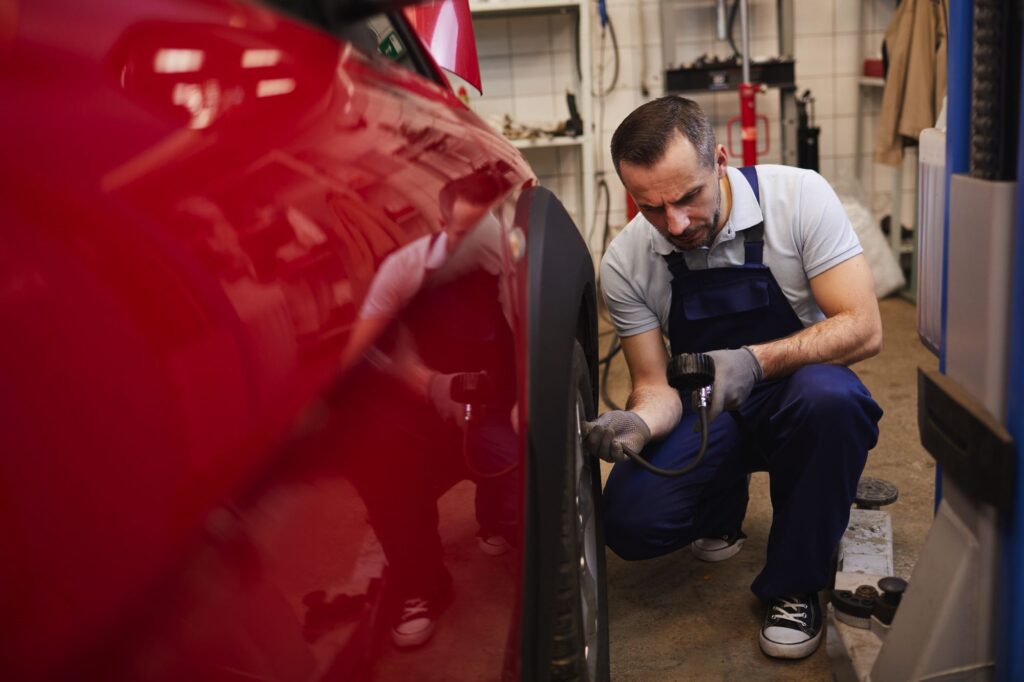
The connection between a driver and the tyres of the car is a big battle against the road. The main roads and the sweeping curves of the Corniche should be well-maintained. Tyre Replacement Signs in Abu Dhabi between the rough sand, the dampness of the Arabian Gulf, and summer temperatures that can melt the rubber. Your tyres in Abu Dhabi break down faster here as comparison to any other place on Earth.
Ignoring the warning signs isn’t just a matter of failing your next ADNOC vehicle inspection. It is a significant safety risk. Here is a comprehensive guide to the signs that your tyres have reached the end of the road in Abu Dhabi.
1. The “Age-Out” Factor: The 5-Year Rule
In many parts of the world, tyres are replaced when the tread wears down. In Abu Dhabi, they often need replacement from a tyre shop near me while they still look “meaty” because of dry rot.
The UAE Regulation: Federal law mandates that online tyres UAE must be replaced every 5 years from the date of manufacture, regardless of their condition.
In addition, The Heat Effect: Intense UV radiation and extreme heat strip the essential oils from the rubber compound, making it brittle.
How to Check: Look for the DOT code on the sidewall (a four-digit number like 1224). The first two digits are the week, and the last two are the year. If your tyres were made in 2021, they are legally reaching the end of their life in 2026.
2. Visual Warning Signs: Cracks and “Crazing”
If you look closely at your tyre’s sidewall and see tiny fractures that resemble a spiderweb or a parched desert floor, your tyres are suffering from oxidative degradation.
- Sidewall Cracking: These cuts or grooves are signs that the rubber is losing its structural integrity. On a high-speed commute from Abu Dhabi to Dubai, these cracks can expand rapidly, leading to a blowout.
- Crazing: This refers to very fine surface cracks. While minor crazing is common, deep cracks that reveal the internal cords of the tyre are a sign of immediate failure.
3. Physical Deformities: Bulges and Blisters
A bulge or a “bubble” on the sidewall is a critical emergency. This usually happens after hitting a curb, a deep pothole, or a speed breaker too fast.
- What it means: The internal fabric or “carcass” of the tyre has ruptured, and the air pressure is now held in only by the thin outer layer of rubber.
- The Risk: There is no way to “repair” a bulge. The tyre could pop at any second. If you spot a bulge while parked at Yas Mall or Corniche, do not drive at highway speeds; go directly to a service center at low speed.
4. Tread Depth and the “Wear Bars”
While heat kills tyres in Abu Dhabi, mileage still plays a role, especially for those commuting daily between Abu Dhabi and the Western Region.
The Legal Limit: The minimum legal tread depth in the UAE is 1.6 mm.
The Wear Indicators: Most modern online tyres UAE have “tread wear indicator bars” built into the grooves. When the surface of the tread becomes level with these bars, the tyre is legally bald.
The Penny Test: If you don’t have a gauge, insert a small coin into the groove. If the outer rim of the coin is clearly visible, your grip levels—especially during the rare but heavy Abu Dhabi rainstorms—are dangerously low.
5. Vibration and “Shimmies”
Not all signs are visual; some are felt through the steering wheel or the seat of your pants.
- Unusual Vibration: While vibration can sometimes mean your wheels are out of balance, it can also indicate internal tyre damage. If the internal belts have shifted or separated due to heat stress, the tyre will no longer be perfectly round.
- Moreover, the “Thumping” Sound: If you hear a repetitive thumping sound that increases with speed. You may have a “flat spot” or an internal delamination.
6. Uneven Wear Patterns
Take a moment to turn your steering wheel all the way to one side and inspect the inner edge of your front tyres.
- Camber/Toe Wear: If one side of the tyre is smooth while the other has deep tread, your alignment is off
- The Abu Dhabi Factor: Hence, with the many roundabouts and U-turns in Abu Dhabi’s city planning, front tyres often wear unevenly on the outer edges. If the “shoulders” of your tyres are bald, your cornering grip and braking efficiency are compromised.
Pro-Tip: The ADNOC Inspection
Additionally if your vehicle registration is up for renewal, remember that Abu Dhabi’s ADNOC Distribution testing centers are very strict. They will check for the DOT date, any visible plugs (repairs) in the sidewall, and tread depth. It is always cheaper and safer to replace your tyres in Abu Dhabi before the inspection than to fail, pay for a re-test, and be forced into a rushed purchase. Also it is necessary for every driver to check the Tyre Replacement Signs in Abu Dhabi timely.